
Cleveland Metroparks Watershed Volunteer Program (WVP) provides opportunities for group and independent research projects.
-
In partnership with The Izaak Walton League of America, WVP volunteers participate in monthly monitoring of local streams and lakes during the winter to measure chloride concentration in waterways. Volunteers receive free test strips and learn how to collect and report their chloride concentration results to Clean Water Hub. The goals of Salt Watch are to raise awareness in the public about the connection between road salt, stream health, and public health, to identify chloride hotspots in freshwater, and to advocate for smarter application of road salt by sharing results with private landowners and local and state agencies. Robust volunteer data collection helps establish reliable baseline information and pinpoint pollution problems so local authorities can address road salt problems and adopt better practices.
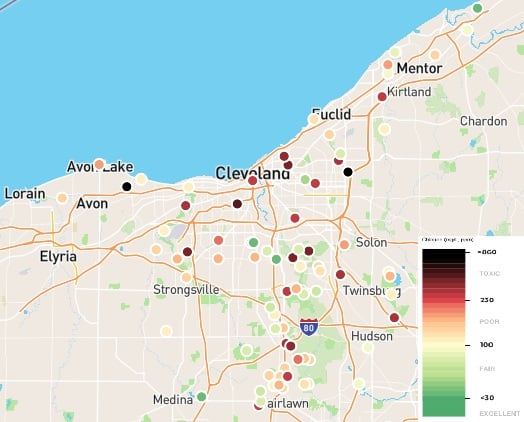
Salt Watch sites and chloride concentration measurements in the Cleveland area.
-
Ohio Scenic Rivers Monitoring
Triannually, lead by Cleveland Metroparks' Aquatic Research Coordinator, Clair Weldon, WVP volunteers participate in Ohio Department of Natural Resources Stream Quality Monitoring Program of Ohio's Scenic Rivers. The mission of the Ohio Scenic Rivers Program is to work cooperatively with local governments, businesses, landowners, non-profit organizations and other state and federal agencies to protect the aquatic resources and terrestrial communities dependent on healthy riparian habitats. Ohio currently has 17 designated Wild, Scenic and/or Recreational rivers comprising 28 stream segments. Rivers and streams in the Ohio Scenic Rivers program are monitored regularly to ensure that the water quality remains high. They are monitored by collecting and counting small aquatic organisms (macroinvertebrates) such as insect larvae, crayfish and snails. Macroinvertebrates are highly effective barometers of a river's health because they have varying tolerances to pollution. The presence, quantity and diversity of macroinvertebrates can be used as an overall indicator of stream health including potential problems. Ongoing monitoring is essential to protecting the health of Ohio's Scenic Rivers.
One of Ohio's Scenic Rivers, the Chagrin River, runs through the Cleveland Metroparks. WVP volunteers monitor the Chagrin River yearly in May, July, and September. Volunteers monitor the same portion of the river 3 times a year and record macroinvertebrates according to their taxon. Each taxon falls in one of three pollution-tolerance groups, 1) pollution sensitive (e.g. stoneflies and mayflies), 2) somewhat tolerant (e.g. crayfish and dragonflies), and 3) pollution tolerant (e.g. aquatic worms and leeches). The grouping is used to calculate the Cumulative Index Value (CIV) which indicates the water quality. The higher the CIV the better the water quality.
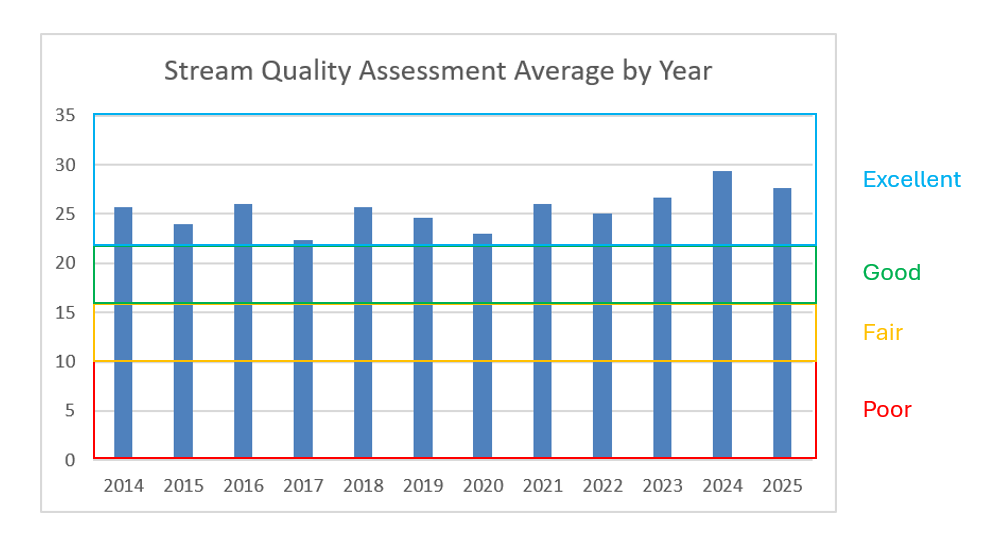
WVP Stream Quality Assessment of the Chagrin River from 2014-2025.
City Nature Challenge
Yearly in the Spring, WVP volunteers participate in City Nature Challenge, an international effort for people to find and document plants and wildlife in cities. It's an annual four-day global bioblitz at the end of April, where cities collaborate to see what can be accomplished when we all work toward a common goal. WVP volunteers identify macroinvertebrates living in Chippewa Creek and record their observations through iNaturalist.
-
In partnership with the National Oceanic and Atmospheric Administration, WVP volunteers participate in the Marine Debris Monitoring and Assessment Project (MDMAP). MDMAP is NOAA's flagship initiative to measure the amount and types of marine debris on shorelines. At monthly WVP events, volunteers monitor our 100m MDMAP site (WVP Euclid Beach) collecting and quantifying the debris in each randomly selected 5m transect. Items are characterized and counted according to material and item type. The data shows the distribution, types, and abundance of debris in the marine environment which can be used to guide policy development, education and outreach, and research initiatives.
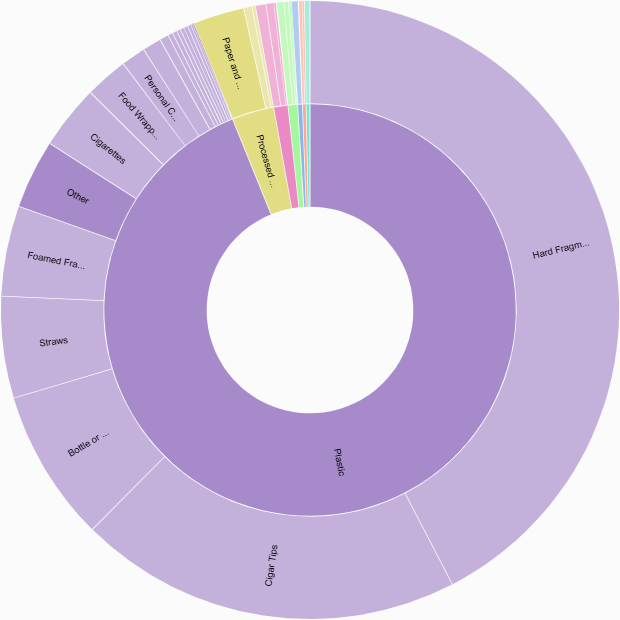
A breakdown of the different types of debris measured to date at WVP Euclid Beach MDMAP site.