
What is Spotted Lanternfly (SLF)?
Spotted Lanternfly (Lycorma delicatula) is a highly invasive insect (planthopper) native to Asia. It was first discovered in 2014 feeding on Tree of Heaven (Ailanthus altissima) in southeastern Pennsylvania. SLF most likely arrived as egg masses on a stone shipment in 2012 near Philadelphia. This insect has the potential to greatly impact agricultural crops such as grapes, hops, and hardwoods. It is also reducing the quality of life for people living in heavily infested area
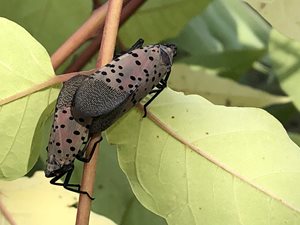
How can I Identify SLF?
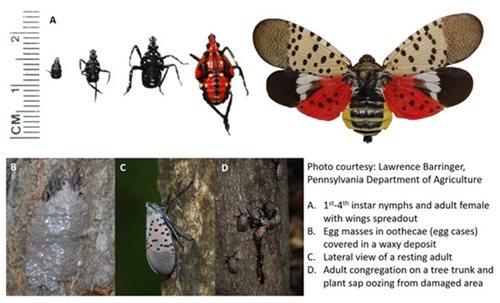
Adult SLF are large and visually striking, measuring approximately one inch long and one-half inch wide. The front wings are grey with black spots, and the hind wings are red, black, and white. The legs and head are black, and the abdomen is yellow with broad black bands. SLF have one generation per year consisting of four nymphal stages, an adult stage, and overwintering as egg masses. Adults are present from July until the first frost. Egg masses are about one inch long and resemble a glossy smear of mud. Adults lay egg masses in the fall on trees, under bark, on rusty metal, on plastic yard objects, on cars and trailers, on outdoor grills, and on many other surfaces.

How does SLF get to new places?
On their own, SLF can move 3 to 4 miles through walking, jumping, and flying. However, the rapid dispersion of SLF is attributed to their ability to hitchhike at all life stages. Nymphs and adults will fly into open windows or into back of trucks while eggs can be found on any outdoor surface from cars, trucks, and railcars. This pest has now spread to 22 states and Washington DC (09/2026).
Where is SLF in Ohio?
SLF was initially found established in Mingo Junction, Ohio in October 2020. In September 2021, several SLF populations were detected in Cuyahoga County. At that time, the Ohio Department of Agriculture (ODA) initiated quarantines for just infected counties. However, in March 2026 ODA established a statewide quarantine due to widespread distribution.
Why I Should Worry About SLF?
SLF feeds on the sugary sap of woody plants by using a piercing-sucking mouthpart that acts like a straw. Adults congregate in the fall to feed on primarily Tree of Heaven. However, adults and nymphs have been found feeding on over 100 different plant species including grapes, black walnut, maples, willow, river birch, black cherry, tulip poplar, and other fruit trees. Large populations of SLF can cause plants to develop weeping wounds and potentially make the tree susceptible to canopy dieback and other bugs and diseases. SLF has the potential to greatly impact the viticulture, tree fruit, nursery, and timber industries.
SLF can be a nuisance just because of their sheer numbers. SLF expels large quantities of excess sugar-water or honeydew in which sooty mold fungi can form damaging plants and covering outside surfaces. Bees and wasps are also attracted to the sweetness which increases the risk of stings.
What does Tree of Heaven look like?
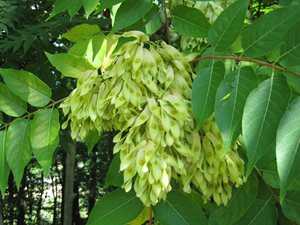
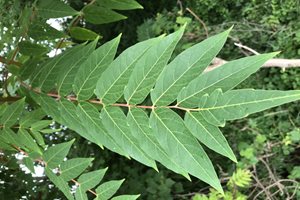
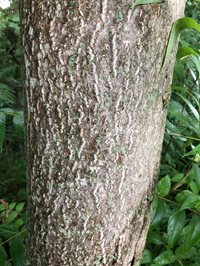
Tree of Heaven is a common invasive tree introduced from China in the late 1700s. This species is a fast-growing tree with the ability to grow on a wide range of site conditions, tolerating poor soils and air quality. Tree of Heaven grows in colonies and is known for its prolific root sprouting. Tree of Heaven can grow to up 80 feet with bark that resembles the skin of a cantaloupe. Leaves are compound with 10 to 40 leaflets. The leaflet margins are smooth with one to two protruding bumps at the base of the leaflet. When crushed, the leaves and all plant parts give off a strong, offensive odor that has been compared to rotten peanut butter. This species is easily confused with some of our native species with compound leaves such as staghorn sumac, black walnut, and hickory, however leaflet edges of the native trees all have teeth.
What is Cleveland Metroparks doing about SLF?
Early detection and ongoing surveys are vital for the protection of our natural resources. Cleveland Metroparks staff and volunteers have been conducting surveys since 2020 mapping locations of Tree of Heaven. Tree of Heaven trees are actively being removed along with squishing any existing SLF populations and destroying egg masses.
How can I help?
Squish it if you see it! Check yourself and vehicle: SLF can be transported as an accidental hitchhiker at any life stage. Always inspect your belongings and vehicle when leaving locations with SLF. Use the check list found HERE to help with inspections. You can also use the Spotted Lanternfly Management Guide found HERE to learn more about management options. You can help slow SLF population growth by installing lampshade traps that contain SLF egg masses. Learn how to build a lampshade trap HERE.
What should I do if I find SLF?
If you suspect a spotted lanternfly infestation, at any life stage, please squish it. The Ohio Department of Agriculture is no longer collecting reports of SLF due to known widespread distribution across the state.
For more information visit:
https://agri.ohio.gov/wps/portal/gov/oda/divisions/plant-health/invasive-pests/slf